Liquid flow sensors for medical technology
Honeywell’s liquid flow sensors are based on an innovative thermal flow sensing principle that is in direct contact with the measured medium and delivers exceptional accuracy and sensitivity. This makes them ideally suited for applications in medical technology and biotechnology.
From dialysis and urology to infusion systems, these high-precision sensors are designed for demanding applications. With a flow range from 0 ml/h to 400 ml/h, they are particularly well suited for controlling highly precise dosing processes.

Operating principle
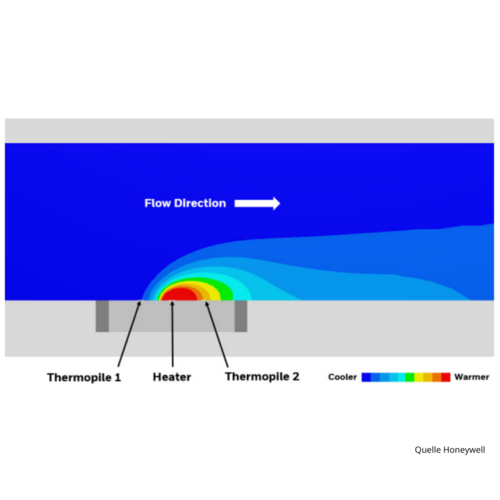
The Honeywell Liquid Flow Sensor operates on the principle of convective heat transfer. A heating element slightly increases the temperature of the liquid, while two thermopiles measure the temperature difference on either side of the heating element. This temperature differential is used to calculate the liquid flow rate, with the amount of dissipated heat being proportional to the thermal properties and flow rate of the medium.
The temperature of the liquid is increased only locally at the sensor element and does not affect the temperature of the liquid leaving the sensor.
If liquid conditions become unstable — for example, due to changes in thermal conductivity — the high sensitivity of the liquid flow sensor detects these fluctuations and signals to the system that changes are occurring in the medium.
All Honeywell liquid flow sensors undergo extensive calibration procedures to ensure a linear output signal. Sensors are factory calibrated for pure water, but can also be calibrated for other liquids to meet the requirements of a wide range of applications.
High adaptability
If required by the application, Honeywell can customise the sensor to create an all-in-one solution that integrates the sensor and microprocessor into a single component.
These all-in-one solutions are typically used in space-constrained applications, such as portable devices that require particularly compact designs. Custom flow calibration is also available.


Distinguishing between different technologies
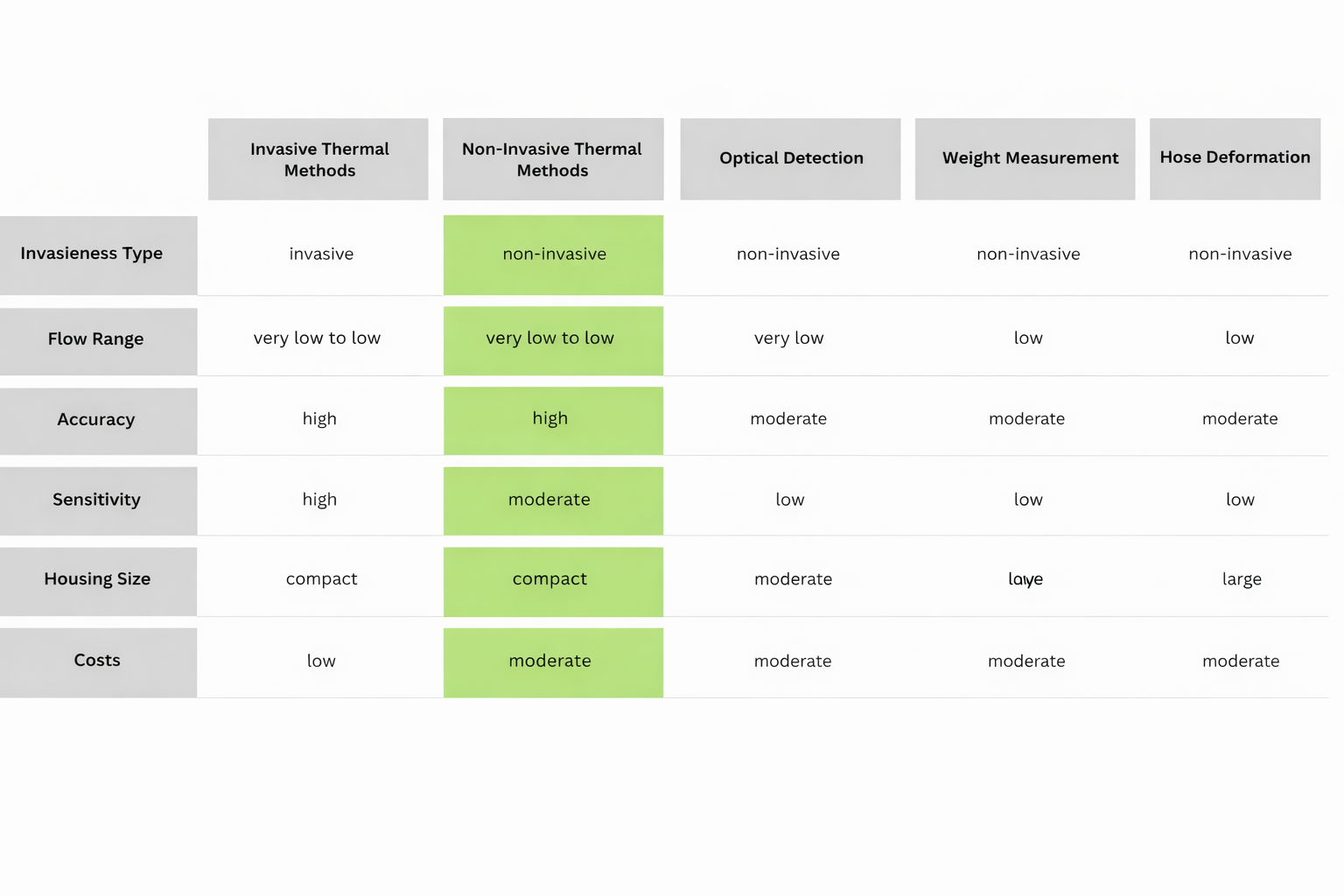
A wide range of technologies is available on the market today for measuring liquid flow, which can make selecting the right solution for a specific application challenging. Some of the most commonly used technologies for low-flow applications include:
- Thermal flow measurement
- Optical drop detection
- Liquid weight measurement
- Tubing deformation measurement
Each of these technologies offers specific advantages and limitations depending on application requirements. When selecting the appropriate flow sensor, several factors should be considered, including:
- Whether the measurement should be invasive or non-invasive
- The required flow range
- The level of accuracy and sensitivity required
- Housing size and available installation space
- Cost considerations
Honeywell liquid flow sensors are ideally suited for applications that require high sensitivity in low flow ranges and allow for non-invasive flow measurement.
The following table provides a clear comparison of common flow sensor technologies and serves as a guide for selecting the most suitable flow sensor type based on application requirements.