AMR and Hall Effect Sensor ICs
Depending on their design, magnetic field sensors react to the presence or absence of a magnetic field in their environment. Hall sensors are among the best-known magnetic field sensors. The sensors function on the basis of the Hall effect, which is named after its discoverer. An adjacent magnetic field causes a charge deficiency on one side of the current-carrying sensor and a charge surplus on the other side. Depending on the design, the internal structure of the sensor triggers a switching process. Other magnetic field sensors react to the Earth's magnetic field and are used for position and location determination.
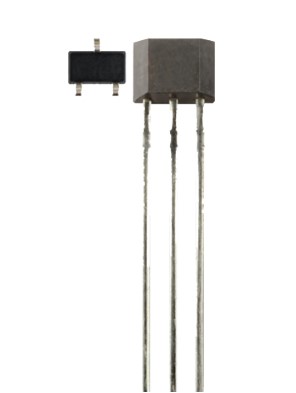
Areas of application
- Current measurement
- Linear and angular position sensors
- Laboratory technology
- Position detection
- Medical technology
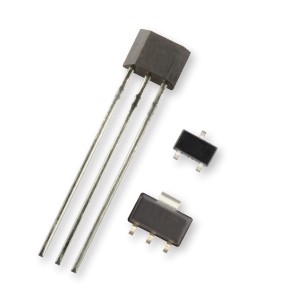
Polarity of a Hall sensor
- unipolar
- Unipolar magnetic field sensors only respond to magnetic fields whose field lines penetrate the sensor from a defined direction. Only then does the sensor switch.
- bipolar
- In bipolar Hall sensors, the sensor responds to field lines from both directions. These sensors are often used as tachometers. There are highly sensitive magnetic field sensors that respond to the Earth's magnetic field. These sensors are typically used for position determination.
- omnipolar
- Omnipolar Hall effect sensors can respond to both the north and south poles of a magnet.
These highly sensitive magnetic field sensors are based on anisotropic magnetoresistive technology. Four permalloy resistors (Wheatstone bridge) form the basic structure of a 1-, 2-, or 3-axis system. These sensors measure the direction and strength of extremely small magnetic fields. The smallest measuring range of these components is ± 200 microtesla. By comparison, the Earth's magnetic field has a strength of approximately 60 µT.
- High flexibility
- Smallest designs
- Versatile assembly options
- High sensitivity
Pressure sensors in the application